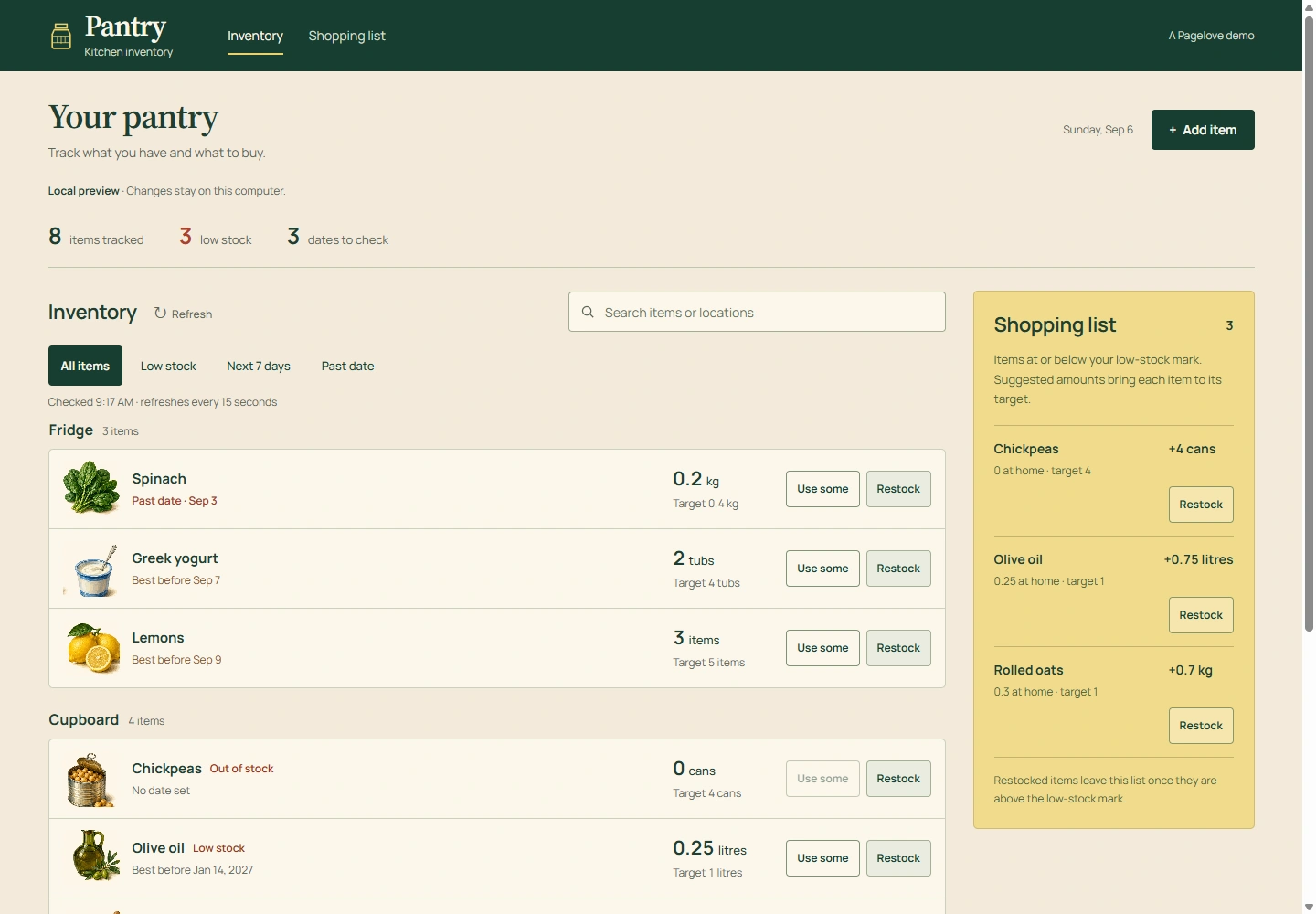
Pagelove stores HTML natively and lets you read and write individual
elements over plain HTTP, addressed with CSS selectors. There is no
backend, no database and no build step in anything below — the page you
are looking at is the data store. Three test what the platform
claims, three make familiar work feel considered, and fifteen ask what it
takes to run a real community on it.
Building twenty-one apps on a platform is mostly a way of finding out
where its documentation and its behavior disagree. The errors were never
the problem — the platform is good at errors. The expensive cases were
the ones where it accepted the request and quietly did nothing.
A read restriction carrying a CSS selector served the content
anyway. The same rule without the selector correctly returned 401.
That fails open, on the first design most people reach for, so every
private thing here lives on its own resource.
A uniqueness constraint keys on the property name across the whole
page, not per schema — so an unrelated foreign-key field sharing a
name broke every write on the page at once.
A state machine over more than one item needs an explicit key before it
can tell two items apart, and an explicit entry rule before you can
create one at all. Neither is in the reference docs.
Template composition that worked perfectly in an isolated test page
returned empty collections, with no error, on real pages. The
counting mechanic never worked at all.
The idiom that took longest to find
Authorization rules have no condition field — there is nothing like
actor == author. Owner-scoping is expressed as a selector
the server fills in from your identity, per request, so the rule can
only ever match your own rows:
AuthorizationRule — edit your own replies, and nobody else's
<!-- the writable element carries the owner as plain data --><liclass="reply"data-author="alice">…</li><divhidden itemscope itemtype="https://pagelove.org/AuthorizationRule"><metaitemprop="actor"content="users"><metaitemprop="method"content="PUT"><metaitemprop="selector"content='[data-author="${request.auth.username}"]'><metaitemprop="action"content="Allow"></div>
What these demos do not prove
No login provider is wired up on this host, so members are seeded as
data and writing is open to anyone. Every rule that gates a
signed-in member is real and deployed, but only its denial path
has been verified from outside — the allow path needs a genuine browser
session, which a deploy key cannot stand in for. Where a demo says
something is private, that means an anonymous request gets a 401, and
you can check it yourself.
Read the write-up, or go break something.
The platform findings went upstream as a pull request against Pagelove's
own developer skill, so the next person building on it starts with them
instead of rediscovering them.